

Make It Unreachable with Raven
You already learned about the new era of EDR with our last blog, now lets dive into Zone 5. Zone 5, data-centric enforcement, is…
Read More
For fifteen years, endpoint security answered a single question: what did this program do on the machine? It was a good question, and EDR answered it well because anything dangerous had to run as a visible process the operating system could watch.
That assumption is coming apart. AI coding agents act with a user’s own permissions. Capabilities connect through live protocols instead of installers. Anyone can assemble a working attack workflow in an afternoon. The dangerous thing is no longer a suspicious new binary, it’s a set of instructions, carried out at machine speed, across steps that each look harmless on their own.
You can’t detect what was never built to be seen.
AI-crafted payloads, living-off-the-land techniques, polymorphic malware, and agentic workflows don’t announce themselves the way EDR needs them to. In its July 2026 Endpoint Control and Prevention (ECP) report, SACR frames this plainly: EDR has run into an architectural ceiling, and prevention has to move ahead of response. This isn’t a performance problem a faster engine fixes. It’s structural. However quick the response gets, the attack is already faster and the gap keeps widening.
If the industry agrees the destination is prevention, the honest next question is: prevention of what, and how early?
Every emerging control races to intervene sooner: pre-deployment gates, mid-flow blocking, intent verdicts, data-movement interception. All of it is a sprint toward the same moment, trying to arrive a half-step earlier than the attacker. But there’s an intervention earlier and more durable than any faster block: give the attacker nothing to aim at in the first place.
Data that can’t be found can’t be encrypted, exfiltrated, or leaked. That’s not a better score on the same board, it’s a different game. And it’s the one move a competitor built on detection can’t simply out-tune, because it doesn’t depend on seeing the threat sooner. It depends on the target not being there.
The fastest response is the one you never have to make.
SACR’s framework maps five zones, from software posture down to Data-Centric Enforcement Zone 5, where the highest-stakes risk lives: ransomware, insider threats, and the exfiltration of IP and sensitive data.
Here’s the tension. Zone 5 is coalescing around a single pattern: classify, trace, and coach. See the data move, then try to intercept it. That produces excellent visibility and forensics. It does not, on its own, produce prevention. SACR makes the point directly: the leading data-lineage platform is forensics-first, and organizations that need real-time prevention should pair it with a prevention-first enforcement layer.
Watching data move isn’t the same as protecting it.
A buyer should feel the gap between being well-informed and being protected and feel uneasy about how much of their spend sits on the wrong side of it.
Most of Zone 5 organizes its thinking around the moment data moves. Arms Cyber adds a control moment earlier than that one — before the data can be discovered or targeted at all and then closes the loop so that a hit never becomes a shutdown. Three moves, one platform:
Conceal. Stealth directories keep critical data out of an attacker’s reach concealed from encryption and exfiltration alike. Even when ransomware or AI-crafted malware executes, it can’t locate what it came for.
Adapt. Decoys lure attackers into false engagements that expose them without touching real data. And when encryption behavior appears, Arms Cyber acts on the real files during execution, minimizing what an attacker can reach.
Restore. Stealth backups sit in concealed enclaves an attacker can’t find or corrupt, with clean restore points and recovery measured in minutes so an incident stays an incident instead of an outage.
It runs as a lightweight sensor alongside your existing EDR/XDR. No reboots. No rip-and-replace. It doesn’t compete with detection, it covers the ground detection was never built to hold.
Protect the data, not just the path to it.
Detection had its era, and it earned it. The next era asks a different question, not what did this program do?, but what can an attacker even find? For anyone competing on seeing threats faster, that’s an uncomfortable question. For everyone defending data, it’s the only one that scales.
You already learned about the new era of EDR with our last blog, now lets dive into Zone 5. Zone 5, data-centric enforcement, is…
Read More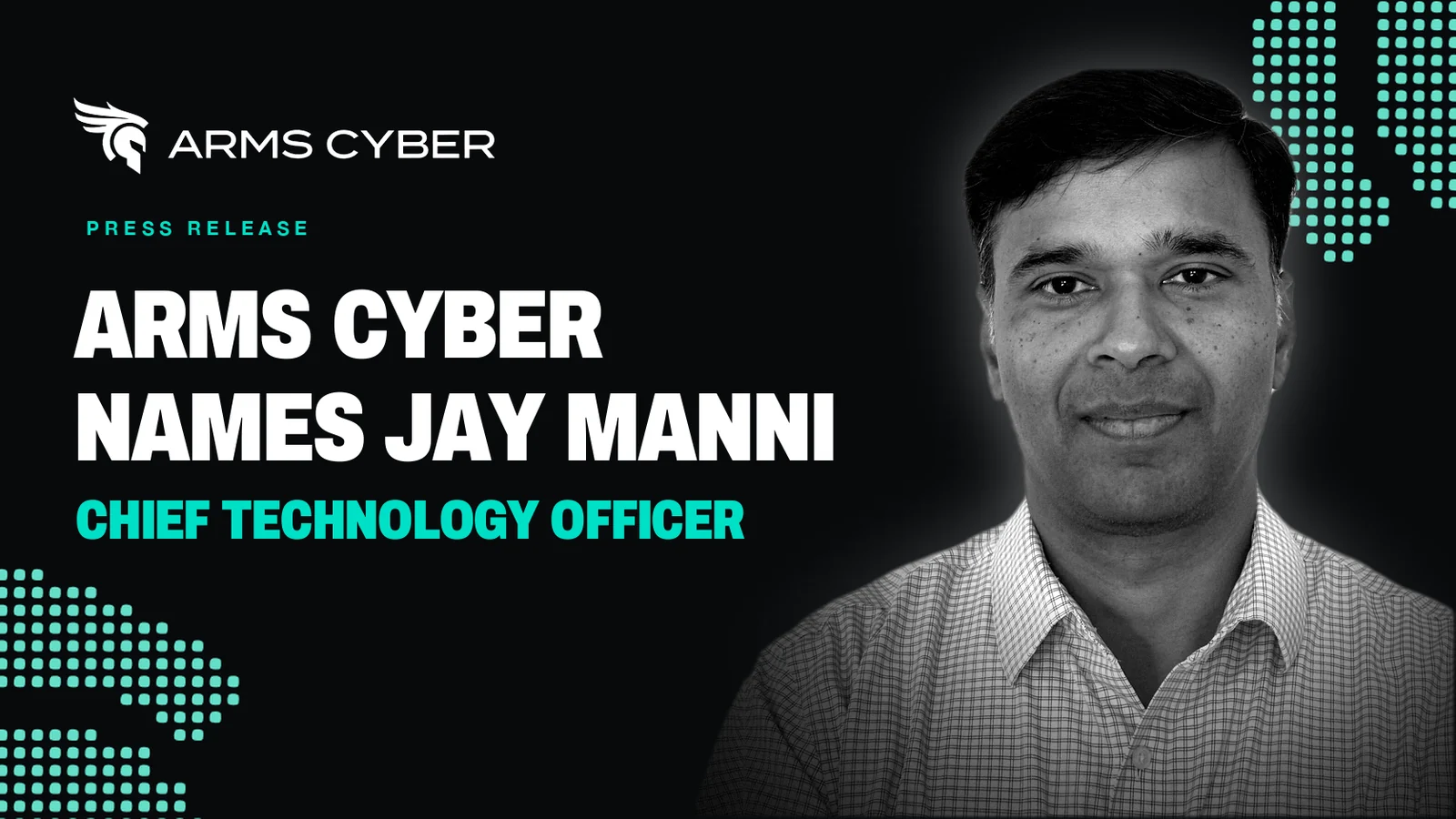
Arms Cyber, the leader in stealth-driven endpoint protection for the AI era, is pleased to welcome Jay Manni to our executive…
Read More
Arms Cyber today announced an expanded investment in its MSSP Program, helping partners deliver enterprise-grade ransomware resilience to…
Read More