


Your AI Policy Can’t Enforce Itself
Security has always known the difference between policy and control. Nobody claims they have a firewall just because they have a…
Read More
A behavioral baseline is not a product you buy. It is a commitment you make – to understand what your environment actually does, so you can immediately recognize and stop what it should never do.
In the old world, security meant knowing what bad looked like. In the new world, security means knowing what good looks like – with enough precision that anything outside that envelope triggers immediate action, regardless of whether the threat has ever been seen before.
A behavioral baseline is a mathematical model of what a specific process, user, or system normally does. It is built from observed runtime data – not threat intelligence feeds. It captures the typical number of file operations per minute, which API calls a process makes, which network endpoints it reaches, what its memory usage pattern looks like, and how it relates to other processes in the chain.
Once established, this baseline becomes the enforcement boundary. Deviation from it triggers action. This is a fundamentally different security posture. Instead of asking whether a threat is known, the system asks whether the behavior is authorized. The answer is always computable. The response is always immediate.
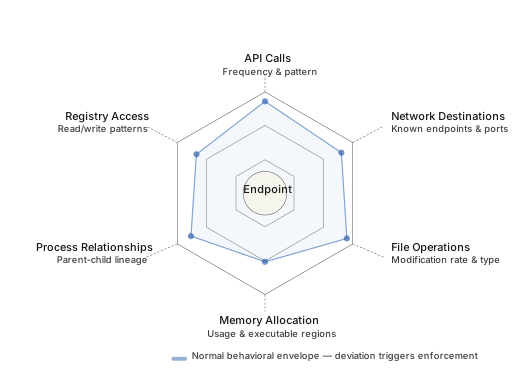
A behavioral perimeter is only as strong as its most incomplete layer. Organizations that profile file system activity but ignore memory allocation, or that monitor network connections but ignore process lineage, create gaps that sophisticated attackers will find. A complete behavioral baseline requires five distinct observation layers working in concert.
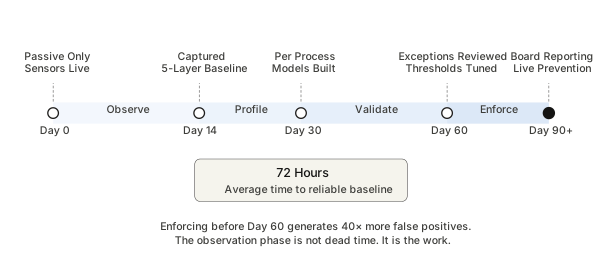
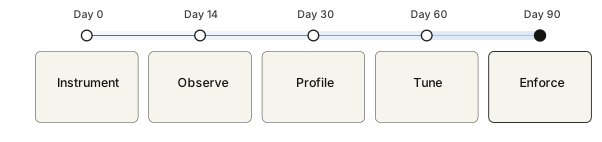
The process of building a behavioral baseline is not instantaneous – it requires an observation period during which the system learns what normal looks like without enforcing anything. Most organizations achieve reliable baselines within 72 hours of observation. The quality of the baseline determines the precision of enforcement: a richer observation period produces fewer false positives and faster detection of genuine threats.
The observation period is not dead time. Organizations that instrument the observation phase correctly emerge with a richer understanding of their own environment than they had before – including undocumented processes, legacy software running unexpectedly, and misconfigured services that were always there but never visible.
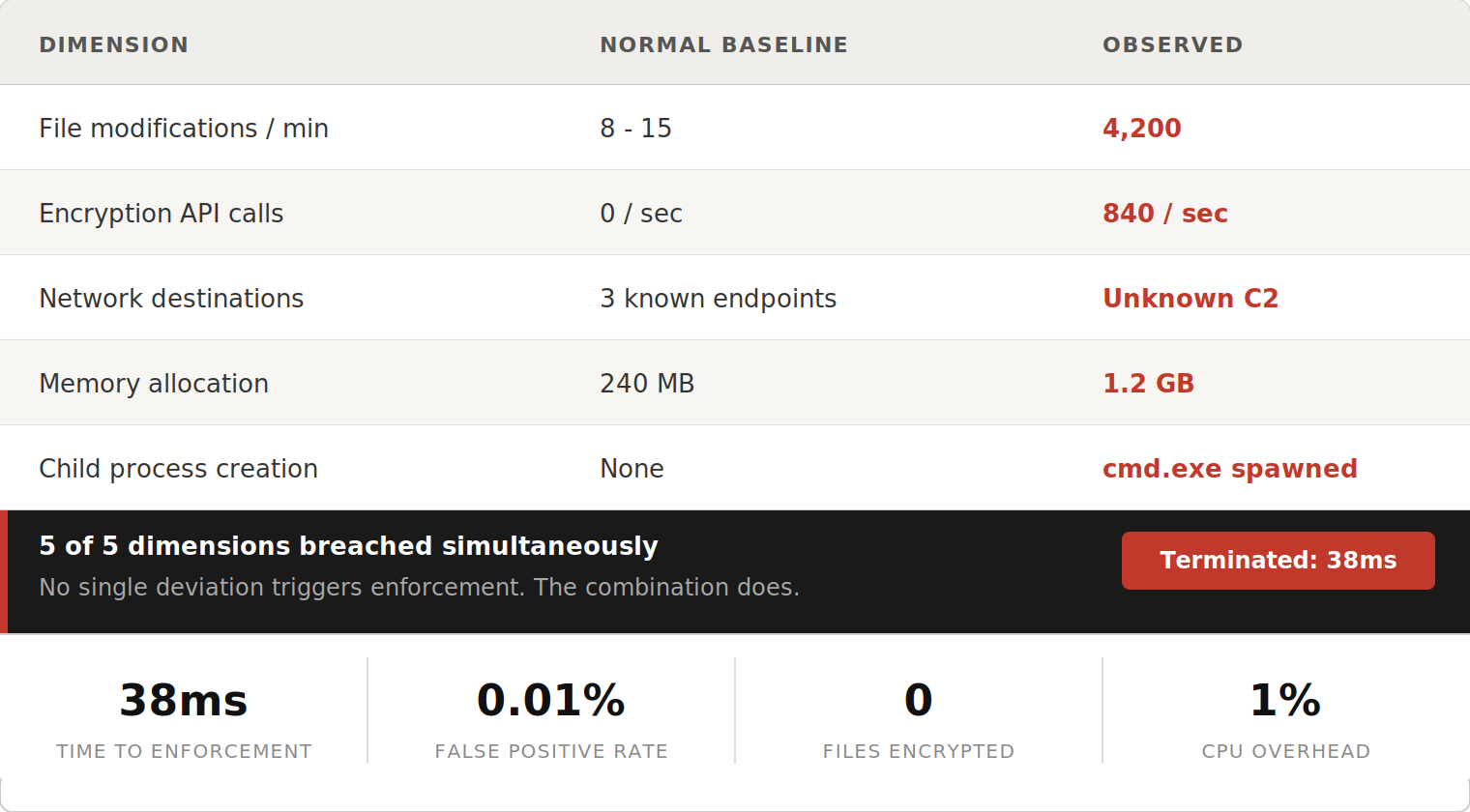
Once the baseline is established, the enforcement engine watches every process in real time against its behavioral model. Deviations are scored across multiple dimensions simultaneously. A single small deviation in one dimension may be acceptable – a combination of deviations across multiple dimensions simultaneously is almost always an attack.
Behavioral baselines are not new in concept – they have been discussed in security research for decades. What is new is the computational power to implement them at enterprise scale without performance impact. Still, resistance is common.
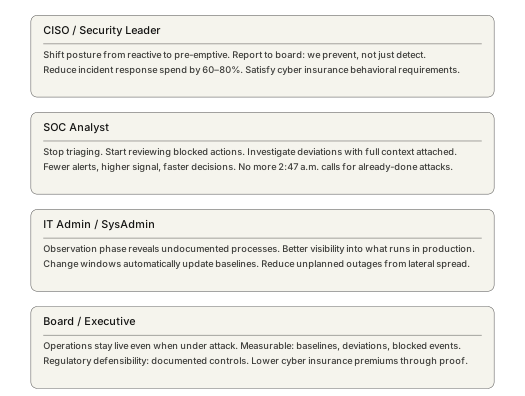
Behavioral baseline deployment does not require a rip-and-replace of existing security infrastructure. It layers on top of what you have. The key discipline is restraint during the observation phase: the temptation to enforce early produces false positives that damage analyst confidence and business trust.
The single most common mistake in baseline deployment is rushing to enforcement mode before the model has matured. Organizations that enforce at Day 14 instead of Day 60 typically generate 40 times more false positives – damaging the credibility of the system before it has a chance to prove its value.
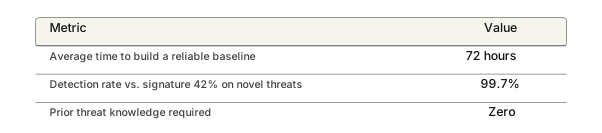
The three metrics every security leader should track once behavioral enforcement is live:
A mature behavioral enforcement deployment blocks 95% of ransomware-class attacks before a single file is encrypted.
The network perimeter was dissolved by cloud. The device perimeter was dissolved by remote work. The identity perimeter is being dissolved by AI-powered credential attacks. What remains – the only defensible boundary in a world where every perimeter has been eroded – is the behavioral boundary of legitimate operations.
Know what normal looks like. Enforce the boundary of normal relentlessly. Everything else is negotiable.
The question is not whether your environment will be targeted. It will be. The question is whether your defense can recognize and stop an attack that has never been seen before, in less time than it takes to encrypt a single file. Behavioral baselines are the only architecture that makes that possible.
Jason T. Williams is the Senior Director of Global Solutions Architecture at Arms Cyber. Our patented Stealth Posture Management platform protects organizations across Windows, Linux, and MacOS by making critical data invisible and resilient to attackers.
Security has always known the difference between policy and control. Nobody claims they have a firewall just because they have a…
Read More
In November 2025, Anthropic published something that should have gotten more attention than it did. The report documented what the…
Read More
For most of the last decade, the security industry treated backups as the final word in ransomware defense. The logic was clean and…
Read More